
© 2026 Monument Traders Alliance, LLC

Close your eyes and picture where the country could be one year from now.
It’s Labor Day weekend 2027, and a new set of hockey sticks in my truck costs less than it did this year because the tariff fight with Canada has finally cooled.
Gasoline is cheaper too, because tankers are moving freely through the Strait of Hormuz again.
Groceries probably aren’t cheaper, they rarely are, but food inflation has cooled enough that I’m not paying another 20% on top of this year’s prices.
Interest rates have backed off today’s extremes, and some of what has investors glued to their screens today will have moved off the front page.
That’s what markets do. Today’s crisis becomes tomorrow’s footnote.
But there’s one thing I don’t expect to change.
A year from now, the fighting in some of today’s hot spots may have slowed, but the bill for those conflicts will still be coming due.
The United States and its allies have spent years drawing down inventories of missiles, interceptors, and other critical weapons supporting Ukraine and responding to conflicts across the Middle East.
Those weapons don’t magically reappear when the shooting stops.
Factories have to build them.
Supply chains have to deliver the components.
Manufacturing capacity has to expand, and stockpiles have to be replenished.
Patriot interceptors and AMRAAM inventories need to be replaced. Tomahawks and other missile systems have to roll off production lines in numbers nobody contemplated a few years ago.
That’s why I can picture something else happening next Labor Day.
While I’m driving to the lake with cheaper gas in the tank, trainloads of missiles and other armaments will be moving toward military bases and ports somewhere else in America.
Raytheon’s (RTX) factories will still be running full tilt, because the company sits squarely in the middle of a multiyear effort to rebuild the arsenal the U.S. and its allies have depleted.
And that’s only half of the Raytheon investment thesis.
Some investors look at the changing battlefield and assume autonomous aircraft, drones and AI threaten traditional defense companies like Raytheon.
I think they have it backward.
Raytheon isn’t just rebuilding yesterday’s arsenal; it’s positioning to supply tomorrow’s battlefield.
That distinction matters because I’d rather not guess which drone company ultimately wins, that feels like trying to pick Joby Aviation (JOBY) over Archer Aviation (ACHR)… neither may win.
I’d rather own the company supplying the technology that makes those systems work.
Pratt & Whitney brings propulsion technology.
Collins Aerospace provides avionics, communications, and connected systems.
Raytheon provides the sensors, guidance, missiles, and counter-drone technology.
That makes Raytheon closer to an agnostic supplier to the autonomous defense revolution.
Instead of betting on which drone manufacturer dominates, RTX can sell propulsion, sensors, communications, guidance, and weapons systems across every platform.
Raytheon’s future is about much more than replenishing a depleted stockpile.
The battlefield is moving toward drone swarms, counter-drone defenses, and systems built to operate with less direct human control. Raytheon intends to be in the middle of that shift.
That matters for the longer-term investment thesis.
We’ve got one enormous spending cycle built around replacing weapons we’ve already used, and another developing around next-generation weapons for a very different battlefield.
Raytheon gets exposure to both.
Now let’s talk about the stock, because knowing what to own is only half of investing. The other half is knowing when to buy it.
I pulled RTX’s monthly seasonality back to 1993, and two months jumped off the screen: August and September.
They’re the only two months where RTX has produced a negative average return since then.
August has averaged a decline of roughly 0.7%, while September has averaged about a 1% decline.
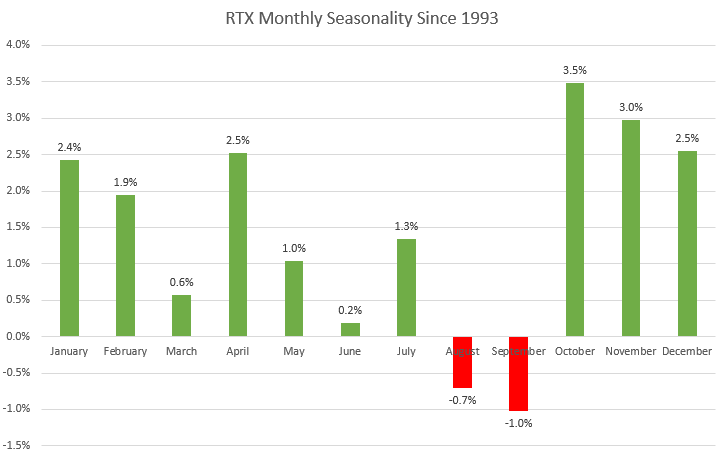
Every other month has averaged a positive return.
More important is what happens when the calendar turns to October.
RTX has averaged roughly a 3.5% gain in October, 3% in November and 2.5% in December, outpacing the major indices during the market’s strongest seasonal stretch.
Seasonality doesn’t guarantee anything, but the historical window for buying RTX on weakness has been remarkably narrow.
And we’re sitting in that window right now.
You won’t hear the phrase “buy the dip” much over the next month.
September has earned its reputation as one of the market’s toughest months, and investors will spend plenty of time debating what to sell, where to hedge, and how much further stocks could fall.
I’m not interested in buying every dip in September, but I am buying this one.
RTX has already pulled back from its August highs and is sitting near its 50-day moving average, right around $205. That’s my first price.
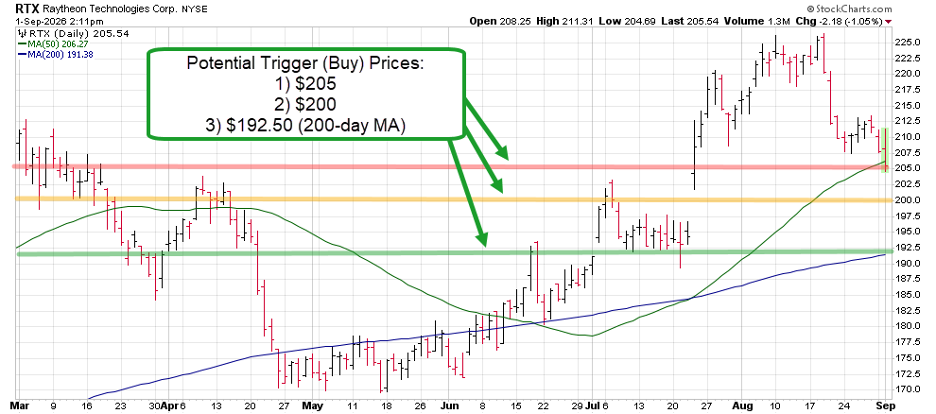
If September does what September often does and volatility pushes RTX toward round-number support at $200, and then $190, where the 200-day moving average sits…
If fear pushes the stock lower without changing the fundamental story, I’d use that weakness to build the position further.
That’s the gift September may be offering: a historically weak two-month window in a company whose long-term fundamental story keeps strengthening.
It’s also worth remembering that Congress returns to business after the November elections, and much of that agenda, spending bills, continuing resolutions, appropriations, will likely center on replenishing the nation’s defense stockpile.
A year from now, the hockey sticks and gasoline may both be cheaper, and much of what’s worrying investors today may have faded into the background.
But Raytheon’s factories will still be running full bore, rebuilding the arsenal we depleted yesterday while building the technology we’ll need on tomorrow’s battlefield.
This September may be the only discount you get until then to buy it.
P.S. Everything above comes down to timing. You need to be positioned before the catalyst hits, not after.
My colleague Matt McCall is watching the same kind of setup in a completely different market.
He’s calling it The Musk Stampede: Elon’s already in, every member of the Magnificent Seven has followed, and Nvidia just took a stake in his top pick.
Matt’s put together four reports on it, starting with the three companies he thinks could ride the next leg of that move.
If you want to see what “early” looks like before the crowd shows up, this is where I’d start.
